Category: All

  • Transitioning from WordPress to MERN Stack Development

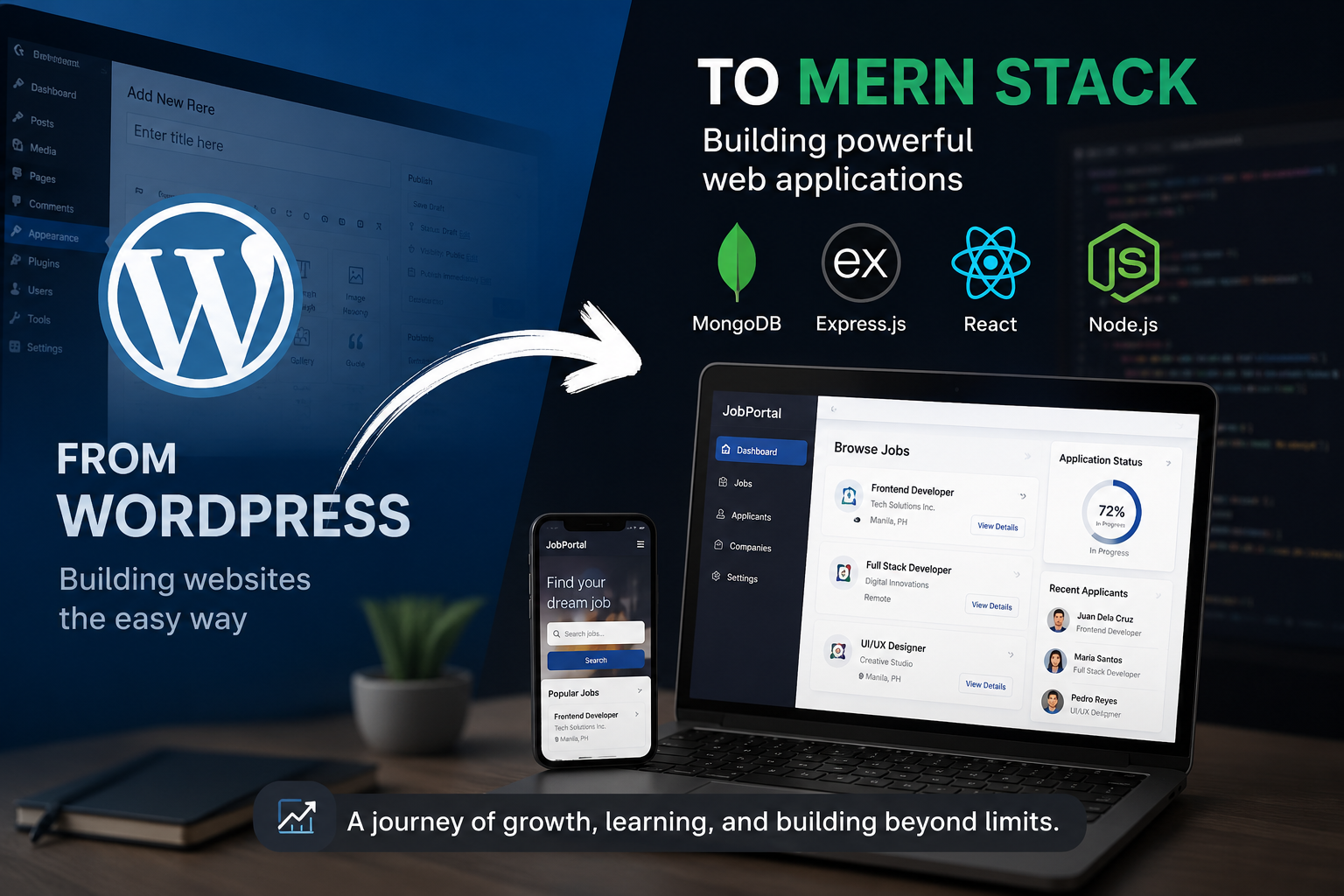
    Transitioning from WordPress to MERN Stack Development

    A few years ago, I started building websites with WordPress. Like many designers, it became my gateway into web development. I loved how quickly I could bring ideas to life using page builders, themes, and plugins. It allowed me to move beyond graphic design and create complete websites for clients and businesses.

    For years, WordPress played a huge role in my career. It helped me grow professionally and became one of the skills I use almost every day at work.

    But over time, I realized I wanted more.

    As projects became more complex, I started running into limitations. While WordPress is an excellent CMS, certain applications and features weren’t practical to build with it alone.

    Some of the challenges I encountered included:

    • Building custom portal web applications
    • Having complete flexibility over UI and user experience
    • Creating highly customized functionality through code
    • Scaling applications beyond what plugins could comfortably support

    That realization pushed me to step outside my comfort zone.

    Why I Joined a Bootcamp

    Instead of staying where I was comfortable, I enrolled in Bootcamp Uplift Code Camp to learn full-stack development using the MERN Stack (MongoDB, Express.js, React, and Node.js).

    It wasn’t because WordPress was “bad.” In fact, I still think it’s one of the best platforms for business websites, landing pages, blogs, and marketing sites.

    I wanted to learn how modern web applications are built from the ground.

    My Job Portal Project

    One of the projects I’m most proud of during bootcamp is a Job Portal application.

    The goal is to help businesses manage recruitment through their own platform instead of relying entirely on third-party job sites.

    Features for Job Seekers

    • Search available jobs
    • View job details
    • Submit applications
    • Upload resumes
    • Track application progress

    Features for Administrators

    • Create and manage job postings
    • Edit existing listings
    • View registered applicants
    • Track applications
    • Update the application status, which is reflected in the applicant’s dashboard

    Building this project taught me how different application development is compared to building traditional websites. Every feature requires planning—from database design and API development to frontend state management and authentication.

    The Learning Curve

    I’ll be honest, it hasn’t been easy.

    React, Express, MongoDB, and Node.js require a different way of thinking. There are moments when debugging takes longer than writing the actual code.

    And yes, I use AI.

    Not to build everything for me, but to speed up repetitive tasks, understand concepts faster, and help me debug problems. I still spend time understanding the code because I believe that’s where real learning happens.

    The goal isn’t to rely on AI; it’s to become a developer who knows when and how to use it effectively.

    Looking Ahead

    This Job Portal is still my “baby project.”

    I’m still in bootcamp, which means there are features I want to improve, bugs to fix, and many ideas I’d like to add in future versions. Every week I learn something new that makes me want to refactor part of the application.

    It’s a continuous process—and that’s what makes software development exciting.

    A New Career Chapter

    My background is in digital marketing, graphic design, and WordPress development.

    Now I’m combining those experiences with full-stack development.

    I believe understanding both design and engineering allows me to build products that are not only functional but also user-friendly.

    I’m excited to see where this journey takes me.

    If you’re considering learning full-stack development, don’t be afraid to start. It’s challenging, but it’s also one of the most rewarding skills you can develop.

    For anyone in the Philippines looking to make the transition, I highly recommend checking out Uplift Code Camp. The experience has challenged me to think differently and helped me grow as both a developer and a problem solver.

    This is only the beginning.

  • Types of Recruiters I’ve Met Along the Way

    Types of Recruiters I’ve Met Along the Way

    After years of applying to different companies, I’ve realized one thing: recruiters come in all shapes, styles, and personalities. Some will make your journey easy, while others will test your patience (and sanity 😅). Here are a few types I’ve met along the way:

    1. The Friendly Recruiter

    This one’s the best! They’ll guide you from start to finish, making sure you know what’s happening every step of the way. You can feel that they genuinely care, like your personal cheerleader throughout your application until your final interview.

    2. The Clingy Recruiter

    They mean well, but wow… they’ll message or call you every day. “Any update?” “Can you send this document again?” You start to wonder if they miss you more than their friends. 😂 Still, at least they’re consistent!

    3. The Ghost Recruiter

    Ah, yes, the most painful one. After the initial interview, poof! They disappear. No messages, no emails, nothing. You keep checking your inbox, hoping for an update that never comes. A week later, you just move on — lesson learned.

    At the end of the day, these experiences teach you a lot — how to stay patient, how to handle rejection, and how to keep showing up. Even when things don’t go your way, just keep applying and showing professionalism. Because in the end, every “no” brings you closer to the right “yes.” 💪

  • Advantages and Disadvantages of Working in a BPO / Offshoring Company

    Advantages and Disadvantages of Working in a BPO / Offshoring Company

    When I was in college, I took up Information Technology. We were introduced to different programming languages, and I still remember the first time we created a simple webpage. I instantly fell in love with web design. I told myself, “One day, I’ll be a website designer.”

    Unfortunately, I wasn’t able to finish college. But even without a diploma, I pursued my dream. I started as a graphic designer, and through years of experience, I eventually became a web designer. My first real experience in this field was through an offshoring company. That’s when I discovered the advantages and disadvantages of working in a BPO / offshoring company.

    Advantages of Working in a BPO / Offshoring Company

    1. Competitive Salary and Benefits

    Most BPO and offshoring companies offer competitive salaries based on your experience. Some even provide free shuttle services, lunch, and HMO coverage starting on your first day.

    2. Work-Life Balance

    Many of these companies operate on a 5-day work week with 2 days off and minimal overtime. Clients value employees’ time and encourage time off with family. If overtime is required, it’s usually paid and well-managed.

    3. Modern Facilities

    BPO offices often have comfortable, luxurious lobbies, well-equipped cafeterias, and convenient locations that are accessible to employees and applicants alike.

    4. Fun Events and Activities

    Team building, sports tournaments, e-game competitions, mid-year celebrations, and year-end parties—these are common in BPO settings. Companies make an effort to build social connections among employees.

    Disadvantages of Working in a BPO / Offshoring Company

    1. Layoffs Can Happen Anytime

    Layoffs are a reality in the BPO industry. If a client ends their contract due to recession or cost-cutting, accounts may be pulled out without prior notice. This means you could lose your job immediately, with little time to prepare.

    2. Shared Workspaces

    If you’re more introverted or prefer privacy, working in a shared setup may be challenging. Sometimes, you’ll share desks and monitors, making it difficult to focus or have private meetings with clients.

    3. Strict Restrictions

    Many BPOs restrict access to social media and entertainment platforms. While it’s understandable, some employees find listening to music helps them focus. Too many restrictions can make the environment feel suffocating.

    4. Promotion and Salary Increases Are Not Easy

    To get a promotion or raise, you usually have to go through your account manager. You can’t negotiate directly with the client, and increases are based on percentages set in your original contract.

    5. Unequal Opportunities

    Some employees get lucky with generous clients who offer perks or overseas travel. Others don’t. This can lead to envy and cause some employees to look for better opportunities elsewhere.

    Final Thoughts

    A BPO or offshoring company can sometimes feel like a parked ship—stable but dependent on the client’s next move. When the client decides to pull out, there’s little you can do. You move on to the next one.

    But despite the uncertainty, the experience you gain is valuable. It builds your resume and helps you grow both professionally and personally.

  • Mega Churches: Houses of Worship or Business Enterprises?

    Mega Churches: Houses of Worship or Business Enterprises?

    Growing up in a Christian environment, I’ve seen the evolution of churches, especially the rise of mega churches. Starting from Sunday school at age 5, I moved through various churches before settling in a mega church where I served for years as a musician.

    Initially, I was drawn to the sense of community and the opportunity to connect with diverse people, including professionals and businessmen. However, over time, I began to notice both the positives and negatives of the mega church model.

    On the positive side, mega churches offer strong community bonds and networking opportunities. However, there’s often a noticeable divide in status between members.

    Mega churches operate like corporations, with branding, marketing, and revenue streams. They sell books authored by their pastors, produce music albums, and host expensive conferences. Pastors often enjoy lavish lifestyles with fancy cars and houses. Their target demographic tends to be affluent business people who can financially support the church.

    Unfortunately, this focus on wealth and status can lead to neglect of ordinary members. Many people, myself included, have felt ignored or disconnected from the church community. Even though I had talents to offer, I found it difficult to access support when needed.

    Have you observed similar patterns in mega churches? What are your thoughts on their approach to spirituality and community?

  • Is the Real Church Dead?

    Is the Real Church Dead?

    The Church began 2000 years ago. It was started by Christ, who chose 12 disciples. After Christ’s crucifixion and resurrection, the Holy Spirit came down to anoint them with the Holy Spirit. John and Peter preached the gospel. In separate events, Saul encountered Christ and became Paul, preaching the Gospel across Israel, and that’s how the church began. 

    Present Church

    Most of the churches implementing the G12, or the gospel twelve, are inspired by Networking in the Philippines. You need to disciple 12 people and also need 12 people. However, not all churches implemented this style. Other discipleships are 1 to 3 people. But currently, discipleship talks about only how to be more prosperous or is just a social club thing. At the end of the day, you will realise that you will face all the struggles on your own. You will just pray alone and ask for strength to overcome all struggles. 

    Growing up in Christianity, I witnessed some people who failed to walk in Christ not because of the scripture but about the community. Somehow, they are pressured by the status symbol, how they are judged by the leaders, and worst the whole church condemns them. 

    I hope that “Mega Church” will not be based on the number of people who attend or several groups of people who are rich or influential. I hope the Church will be a safe refuge, help you become a better person, and lead you on a good path. 

    And they devoted themselves to the apostles’ teaching and the fellowship, to the breaking of bread and the prayers. And awe came upon every soul, and many wonders and signs were being done through the apostles. And all who believed were together and had all things in common. And they were selling their possessions and belongings and distributing the proceeds to all, as any had needed. And day by day, attending the temple together and breaking bread in their homes, they received their food with glad and generous hearts, praising God and having favour with all the people. And the Lord added to their number day by day those who were being saved.

    Acts 2:42–47